How Loudoun turned server farms into 40% of its tax revenue — and why it’s now tightening the rules
A Data Center Fight in Virginia
Loudoun County, Virginia, embraced data centers earlier and more aggressively than almost anywhere in America. The result: huge tax revenues, lower property tax rates and major public investment — but also growing fights over power, land use, noise and how much more development the county can absorb.
Here are five takeaways from Loudoun’s data-center boom:
1. Loudoun County, VA got in early — and made a fortune from it
- Loudoun benefited from early fiber infrastructure, and America Online’s arrival in the city of Ashburn in the 1990s and zoning rules made data centers relatively easy to build.
- Today, the county has more than 250 data centers, with more still planned.
- Taxes on the equipment inside those facilities are expected to generate roughly $1.3 billion next year — about 40% of county tax revenue.
- Data-center tax revenue rose from about $150 million a decade ago to $1.1 billion last year.
- That money has helped Loudoun lower its real-property tax rate and fund schools, roads, public safety and recreation.
2. But the county is now heavily dependent on the industry
- Data centers have become one of Loudoun’s biggest sources of revenue.
- That creates a risk: if investment slows, equipment values fall or companies change how quickly they replace servers, county revenues can move with them.
- Loudoun officials have acknowledged that dependence and have taken steps to build reserves against future swings.
- The broader lesson: data centers can dramatically strengthen a local tax base, but relying too heavily on one industry comes with its own fiscal risk.
3. Power, land and quality-of-life concerns are catching up
- Electricity is the biggest issue. Virginia’s nonpartisan Joint Legislative Audit and Review Commission found that continued data-center growth could require major new generation and transmission infrastructure.
- Residents near facilities have complained about noise, generators, turbines and new power infrastructure. One Loudoun homeowner was told a 185-foot transmission tower could be built near her property.
- Loudoun already has about 53 million square feet of data-center space — roughly 920 football fields.
- Water is more complicated. Loudoun invested early in reclaimed-water infrastructure, allowing some facilities to use treated wastewater instead of drinking water for cooling.
- There is not strong evidence of a countywide health crisis, but Virginia has continued studying issues including noise and localized air pollution.
4. The politics have changed
- What began as an economic-development success story has increasingly become a political issue over electricity costs, land use and growth.
- Data centers became a major issue in Virginia politics during the 2025 election cycle as candidates debated their effects on the grid and utility bills.
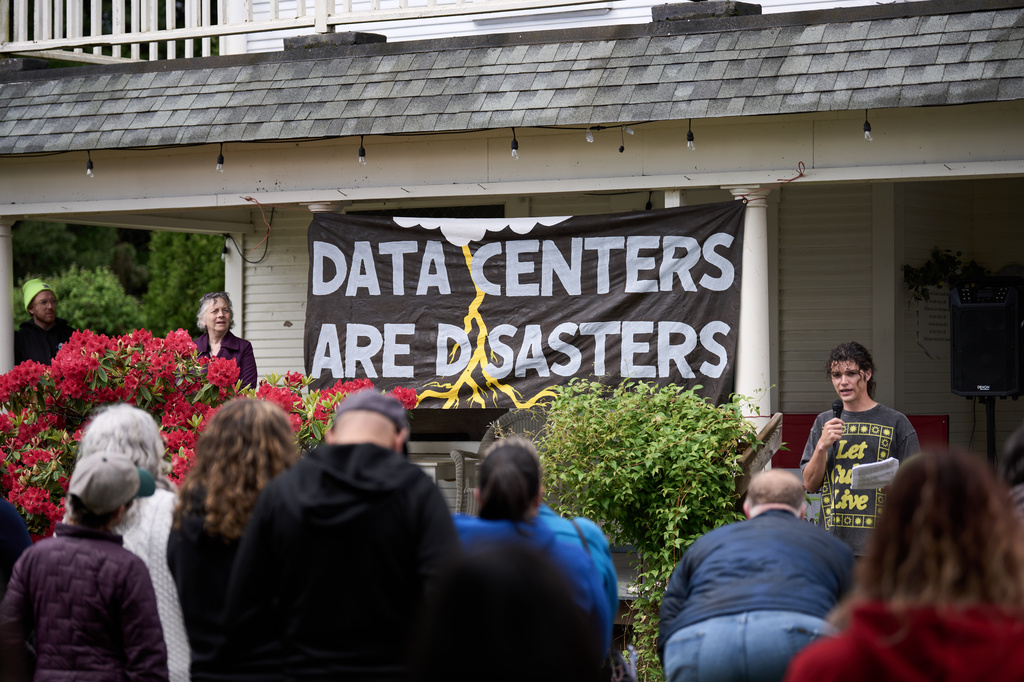
- Loudoun itself has started tightening the rules. The county ended the longstanding system that allowed many data centers to be built “by right,” giving local officials and residents more say over new projects.
- In July 2026, Supervisor Juli Briskman went further, proposing a temporary pause on new applications while the county reassesses its approach.
5. Rural counties face a very different calculation
- Developers are increasingly looking beyond Northern Virginia as available land becomes harder to find.
- For rural counties, even a handful of data centers could produce a major new source of tax revenue.
- But those communities may not have Loudoun’s existing electric grid, water system, planning capacity or tax base to absorb rapid growth.
- That tension was visible in Louisa County, Virginia where Amazon withdrew a proposed 7.2-million-square-foot data-center campus after opposition over water, noise, rural land and infrastructure.
- Opponents there even adopted the slogan “Don’t Loudoun my Louisa.”
The takeaway
Loudoun shows both sides of the data-center boom.
The county has collected extraordinary revenue and used it to support public services and lower tax rates. But after two decades of rapid growth, it is also tightening its rules and confronting real questions about electricity, infrastructure, and dependence on a single industry.
For communities considering data centers today, the question may not simply be whether to welcome them or reject them. It is about capturing the economic benefits while ensuring the infrastructure costs and quality-of-life impacts are managed along the way.
Related

Austin Milks
Austin Milks is Deputy Research Director at No Labels. He has a degree in Political Science from the University of Wisconsin-Whitewater and a JD from Valparaiso University. He has worked for numerous campaigns over the last fifteen years.