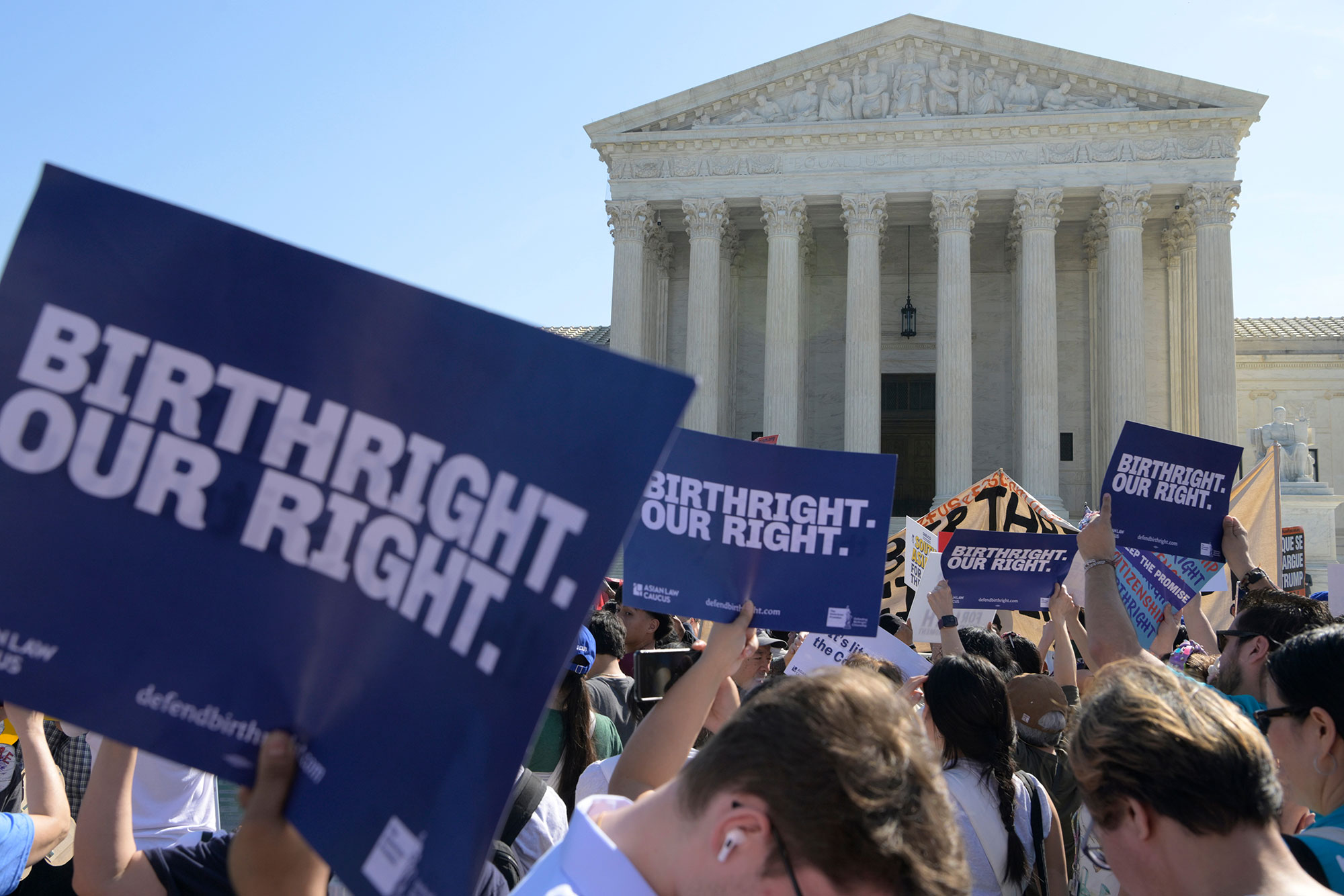
The Supreme Court blocked the tariffs.
The Court ruled that the President cannot use the International Emergency Economic Powers Act (IEEPA) – a national emergency law passed in 1977 – to impose broad tariffs on imports from multiple countries.
What the legal fight was about:
The Trump administration argued that IEEPA’s authority to “regulate importation” included the power to impose tariffs. The Court held that tariffs implicate Congress’s taxing power and require a clear delegation, which IEEPA does not provide.
Who voted which way:
Chief Justice John Roberts wrote the majority opinion and was joined by Justices Neil Gorsuch and Amy Coney Barrett, both of whom were appointed by President Trump in his first term. Justices Elena Kagan, Sonia Sotomayor, and Ketanji Brown Jackson concurred in the judgment but relied on different reasoning. Justices Clarence Thomas, Brett Kavanaugh, and Samuel Alito dissented, arguing that IEEPA should be interpreted more broadly and that it authorizes the tariffs.
Tariffs at issue and the Court’s holding:
The administration invoked IEEPA to impose a baseline tariff of roughly 10% on most imported goods, with higher rates — in some cases reaching 25% — applied to imports from selected countries. The measures were implemented under a declared national emergency.
In a 6–3 decision, the Court concluded that IEEPA does not clearly authorize such broad tariffs. As a result, the emergency tariffs issued by President Trump under IEEPA cannot stand.
What it Means Now
The IEEPA tariffs are no longer valid
Because the Court held that IEEPA does not authorize tariffs, the emergency tariffs imposed under that statute cannot remain in effect.
Executive authority was narrowed
The Court reinforced that tariffs are a core Article I taxing power under the Constitution, and they require clear congressional authorization – IEEPA cannot be interpreted to authorize broad trade policy changes absent clear statutory language.
Congress now holds the leverage
If broad tariffs are to continue, Congress must authorize them directly, or the administration must rely on other, narrower trade statutes (such as Section 232 or Section 301), which come with procedural limits and caps.
In Short
President Trump cannot use IEEPA as a flexible, on demand tariff tool; future trade actions will have to follow other trade laws or receive congressional approval.
What Happens Next
The decision resolves the legality of tariffs imposed under IEEPA
The Supreme Court affirmed the Federal Circuit’s ruling striking down the tariffs and closed out the D.C. case, so the administration cannot revive those tariffs under IEEPA.
The administration has signaled they will pivot to other trade laws
President Trump can still rely on other laws Congress has expressly authorized including:
- Section 232 (Trade Expansion Act of 1962): Allows tariffs tied to national security findings after a Commerce Department investigation.
- Section 301 (Trade Act of 1974): Permits tariffs in response to unfair foreign trade practices after a USTR investigation.
- Section 122 (Trade Act of 1974): Allows a temporary import surcharge (up to 15% for 150 days) in balance-of-payments emergencies. President Trump has said he plans to impose a global tariff under this authority. Any extension beyond 150 days would require congressional approval.
- Tariff Act of 1930 (popularly known as Smoot-Hawley, after the sponsors of the bill) authorities: Provide targeted anti-dumping and countervailing duties after formal investigations.
These alternatives are legally viable – but slower and more constrained
Unlike IEEPA, these statutes require agency investigations, formal findings, procedural steps, and, in some cases, caps on duration or tariff rates.
Congress now has greater leverage over future tariff authority
If broader, more flexible tariff authority is desired by the White House, Congress would need to legislate explicitly – or revise the delegation frameworks already in place.
Related

Austin Milks
Austin Milks is Deputy Research Director at No Labels. He has a degree in Political Science from the University of Wisconsin-Whitewater and a JD from Valparaiso University. He has worked for numerous campaigns over the last fifteen years.