


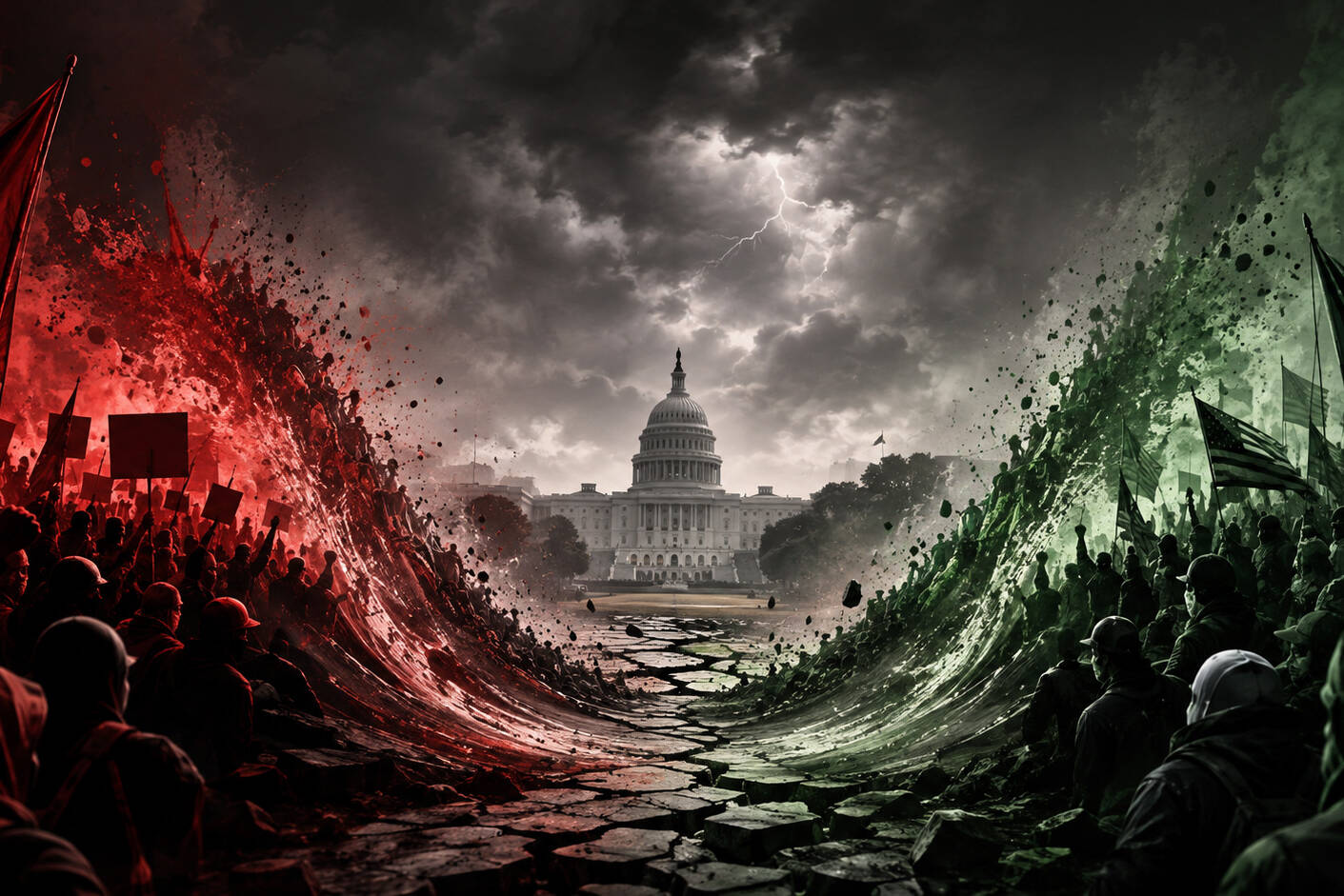
I want to tell you about something strange and disconcerting happening in American politics right now. The war in Iran has revealed how the far right and far left are coming full circle.
Americans have wildly different views on this conflict, and the beauty of our democracy is that everyone gets to freely share them. But what is coming out of the far right and far left is something ugly and different.
Tucker Carlson called the strikes conducted by America and our allies against Iran “absolutely disgusting and evil,” and says the U.S. was pushed into this war by Chabad, a Jewish spiritual movement. Nick Fuentes, a far right white nationalist with over a million followers on X, is telling his followers to skip the midterms or vote Democrat. Marjorie Taylor Greene, having resigned from Congress in January over her falling out with the President, says Carlson should run for president.
On the far left, Michigan Rep. Rashida Tlaib said, “Both the U.S. and genocidal Israel doesn’t [sic] care about the laws. This is who they are.” That is an elected member of Congress talking about the U.S. in the third person as if it is a foreign and evil country. In Illinois, progressive congressional candidate Kat Abughazelah said – contrary to all available evidence – that the United States is “carpet bombing Iran indiscriminately.”
These voices go well beyond being against the war. Listen closely, and it is not hard to conclude they hope America fails and will do or say anything to paint the U.S. in a bad light.
Meanwhile, the hypocrisy from the rest of both parties is something to behold. The position on Iran far too many members of Congress are taking is seemingly driven more by politics than principle. Let me walk you through it.
President Trump just launched airstrikes on Iran without advance congressional authorization. In 2011, President Obama did something very similar against Libya. If a member of Congress were guided by principle, you might assume they would say both presidents either had the power to act or did not.
Of course, that is not what happened. Just look at how leading Democratic and Republican senators had very different reactions, depending on whether the president was from their party.

Neither side is consistent. Both treat the War Powers Resolution of 1973 like a jersey they put on when the other party controls the White House and take off when it is their turn.
There are some issues where you can give leaders a pass for being political. The question of war and peace is not one of them. No member of Congress should be talking about the war in Iran as if it is another campaign issue to exploit for the 2026 midterms.
Yesterday, four Democrats voted against a War Powers Resolution sponsored by Reps. Ro Khanna and Thomas Massie that sought to force an immediate end to U.S. military action: Representatives Henry Cuellar, Jared Golden, Greg Landsman, and Juan Vargas. While Golden said he disagreed with the White House strategy and its lack of clarity, he thought it would be damaging to do an “about face,” when “servicemembers are actively engaged in hostilities, and our allies are under attack.” Rep. Landsman said he believed the military and our allies needed the latitude to “finish this particular operation,” to destroy the Iranian regime’s “missiles and the launchers and the ships.”
You can disagree with these statements and many no doubt will. What you cannot do is say these members are being political, because they were all under immense pressure to fall in line and vote with their party.
They did not. They judged the situation and did what they thought was right – not for their party – but for the country.
Is that not what we want to see from our leaders?
Ryan Clancy




You must be logged in to post a comment.